

The Future of AI in 2026: Opportunities, Risks, and Real-World Impact
Introduction to the AI-Driven Era
The Future of AI in 2026 is no longer a distant prediction but a present reality. Artificial Intelligence has evolved from research laboratories and science fiction into a powerful force shaping businesses, governments, education systems, and everyday life. In 2026, AI technologies are more accessible, cloud-based, and user-friendly, allowing organizations of all sizes to adopt intelligent systems. The Future of AI in 2026 represents a turning point in global digital transformation and economic growth.
Rapid Evolution of Artificial Intelligence
The journey toward the Future of AI in 2026 has been extraordinary. Early AI systems were limited to rule-based automation and repetitive tasks. Today, AI can understand context, generate human-like responses, create visual content, and analyze complex datasets in seconds. Machine learning and deep learning models continuously improve by identifying patterns and adapting to new information. This rapid advancement has accelerated AI adoption across industries and made intelligent systems more affordable and scalable.
Workplace Transformation and Job Evolution
One of the most discussed aspects of the Future of AI in 2026 is its impact on employment. Automation has replaced several routine and repetitive roles, especially in data entry, administrative work, and basic customer support. AI-powered chat systems and automated software now handle large volumes of tasks efficiently.
However, the Future of AI in 2026 is not solely about job displacement. It has also created new professional opportunities such as AI specialists, machine learning engineers, data analysts, AI trainers, and ethics consultants. Organizations now require employees who can collaborate effectively with intelligent systems. Adaptability, digital literacy, and analytical thinking have become essential skills in the modern workforce.
AI in Healthcare and Medical Innovation
Healthcare is one of the most positively impacted sectors in the Future of AI in 2026. AI-powered diagnostic tools analyze medical images with high accuracy, enabling early disease detection. Predictive analytics helps hospitals identify high-risk patients and improve treatment planning. AI also accelerates drug discovery by processing biological data at unprecedented speed.
Personalized treatment plans are becoming more common as AI evaluates patient history, genetics, and lifestyle patterns. In the Future of AI in 2026, AI enhances medical decision-making rather than replacing healthcare professionals.
Education in the Age of Intelligent Systems
Education has transformed significantly in the Future of AI in 2026. AI-powered learning platforms adjust lesson difficulty according to student performance and provide real-time feedback. Teachers benefit from automated grading systems, allowing them to focus more on student engagement and mentorship.
Language translation and virtual learning tools powered by AI are making education more inclusive and globally accessible. The Future of AI in 2026 ensures that learning becomes more personalized, efficient, and adaptive.
Business Strategy and Data-Driven Growth
Businesses increasingly rely on AI for strategic decision-making. The Future of AI in 2026 includes predictive analytics that studies customer behavior, market trends, and purchasing patterns. Companies now create highly personalized marketing campaigns and optimize supply chains using AI-driven insights.
Customer service automation, intelligent inventory management, and operational efficiency provide organizations with competitive advantages. The Future of AI in 2026 empowers businesses to operate smarter and grow faster in complex global markets.
Ethical Concerns and Responsible Innovation
Despite its advantages, the Future of AI in 2026 raises important ethical concerns. Data privacy remains a critical issue, as AI systems require extensive datasets to function effectively. Governments and organizations are implementing stricter regulations to ensure transparency and responsible data use.
Bias in AI models is another challenge. If training data contains historical discrimination, AI systems may unintentionally replicate unfair outcomes. Responsible AI development, fairness audits, and accountability measures are essential to ensure trust in the Future of AI in 2026.
Creativity and Human-AI Collaboration
Generative AI tools have transformed creative industries. In the Future of AI in 2026, writers, designers, and content creators use AI to generate ideas, drafts, and visual concepts quickly. However, creativity still depends on human imagination, emotion, and storytelling.
Rather than replacing creative professionals, AI acts as a collaborative partner. The Future of AI in 2026 highlights synergy between human intelligence and machine efficiency.
Small Businesses and Expanding Accessibility
A defining feature of the Future of AI in 2026 is accessibility. Affordable subscription models and cloud platforms allow small and medium-sized enterprises to integrate AI without heavy investment. These businesses can automate customer engagement, analyze sales data, and improve digital marketing strategies effectively.
This democratization of AI technology levels the competitive landscape and encourages entrepreneurship worldwide.
Global Economic Impact
The Future of AI in 2026 is reshaping the global economy. Nations investing in AI research and infrastructure are experiencing faster growth and increased competitiveness. AI-driven automation improves manufacturing efficiency, strengthens financial systems through fraud detection, and enhances predictive investment strategies.
Introduction to the AI-Driven Era
The Future of AI in 2026 marks a defining stage in the evolution of technology and society. Artificial Intelligence is no longer limited to research institutions or science fiction narratives. It has become deeply embedded in modern life, influencing how businesses function, how governments shape policy, and how individuals communicate, learn, and make decisions.
By 2026, AI technologies are integrated into smartphones, enterprise systems, healthcare platforms, financial institutions, and educational tools. The speed at which AI has evolved over recent years is unprecedented. What once required expensive infrastructure and advanced technical expertise is now available through cloud platforms and user-friendly applications.
The Future of AI in 2026 represents more than technological progress; it reflects a structural shift in the global economy. AI is driving digital transformation, increasing efficiency, and redefining competitiveness across industries.
The Rapid Evolution of AI Technology
The path toward the Future of AI in 2026 has been marked by rapid innovation. Early AI systems focused on rule-based automation, executing predefined instructions for repetitive tasks. These systems lacked adaptability and contextual understanding.
Today, AI models can process natural language, recognize images, generate creative content, and analyze complex datasets in real time. Machine learning and deep learning systems continuously improve by identifying patterns and learning from new data inputs. Unlike earlier generations of software, modern AI adapts dynamically without constant human programming.
The accessibility of AI tools has also increased significantly. Startups, small businesses, and independent professionals can now integrate AI solutions without massive capital investment. This widespread adoption is accelerating global innovation and shaping the Future of AI in 2026 into a collaborative and scalable ecosystem.
Workplace Transformation and Job Evolution
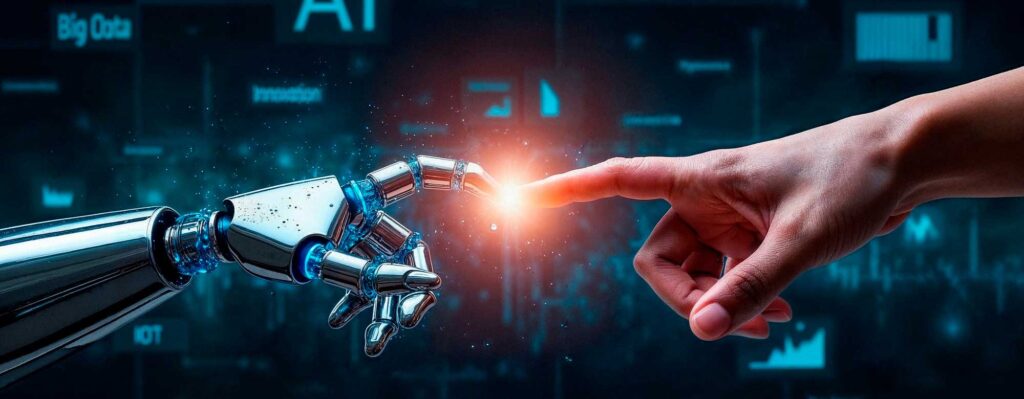
Few topics generate as much debate as employment in the Future of AI in 2026. Automation has replaced certain repetitive and routine functions, particularly in administrative roles, data processing, and basic customer service. AI-driven chat systems now handle large volumes of queries instantly, and automated analytics platforms process data more efficiently than manual systems.
However, the narrative extends beyond job displacement. The Future of AI in 2026 has created entirely new professional categories. Organizations increasingly seek AI engineers, machine learning specialists, prompt designers, data scientists, automation strategists, and AI ethics advisors.
Rather than eliminating human involvement, AI is reshaping the skills required for career success. Critical thinking, digital literacy, creativity, and adaptability are becoming essential competencies. Employees who understand how to collaborate with intelligent systems are better positioned for growth in this evolving landscape.
AI in Healthcare and Medical Innovation
Healthcare stands among the most transformative sectors within the Future of AI in 2026. AI-powered diagnostic tools analyze medical imaging with remarkable precision, assisting physicians in detecting diseases at earlier stages. Early diagnosis improves treatment outcomes and reduces long-term healthcare costs.
Predictive analytics systems evaluate patient data to identify high-risk individuals, enabling preventive care strategies. AI also accelerates pharmaceutical research by analyzing molecular structures and biological datasets at speeds unattainable through traditional methods.
Personalized medicine is becoming more practical as AI systems assess genetic information, lifestyle patterns, and medical histories. In the Future of AI in 2026, technology strengthens medical decision-making while preserving the essential role of healthcare professionals.
Education in the Age of Intelligent Systems
Education is undergoing profound transformation in the Future of AI in 2026. Intelligent learning platforms adjust content difficulty based on student performance, offering personalized educational pathways. Students receive real-time feedback that helps them address weaknesses more effectively.
Teachers benefit from automated grading systems and administrative assistance, freeing time for mentorship and interactive teaching. AI-powered language translation tools make global learning environments more inclusive by breaking communication barriers.
Virtual classrooms enhanced by AI simulations create immersive learning experiences. As a result, the Future of AI in 2026 supports equitable access to high-quality education across geographic and economic boundaries.
Business Strategy and Data-Driven Growth
Businesses rely heavily on AI for strategic insight in the Future of AI in 2026. Predictive analytics tools examine consumer behavior, market patterns, and purchasing trends to guide decision-making. Companies now design highly targeted marketing campaigns based on AI-generated insights.
AI optimizes supply chain operations, improves inventory management, and reduces operational costs. Customer service automation enhances response speed and satisfaction.
Organizations that successfully integrate AI technologies gain competitive advantages in increasingly data-driven markets. The Future of AI in 2026 highlights how intelligence, efficiency, and speed define corporate success.
Ethical Questions and Responsible Innovation
Despite its advantages, the Future of AI in 2026 raises critical ethical considerations. Data privacy remains a significant concern because AI systems require extensive datasets for effective performance. Governments are introducing stricter regulations to ensure transparency and responsible data management.
Algorithmic bias presents another challenge. If AI systems are trained on historically biased data, they may replicate unfair outcomes. Organizations must conduct fairness audits and implement accountability frameworks to maintain trust.
Over-reliance on automation is also debated. Excessive dependence on AI could reduce human critical thinking and decision-making skills. Therefore, responsible innovation is central to shaping a balanced Future of AI in 2026.
Creativity and Human Collaboration
Generative AI tools are redefining creative industries in the Future of AI in 2026. Writers, designers, filmmakers, and marketers use AI to generate drafts, visuals, and innovative ideas quickly. Production cycles are becoming shorter, and experimentation is easier than ever.
However, emotional intelligence, storytelling depth, and cultural understanding remain uniquely human attributes. The Future of AI in 2026 emphasizes collaboration rather than replacement. When human creativity combines with AI efficiency, innovation reaches new heights.
Small Businesses and Expanding Accessibility
Previously, AI implementation required significant investment, limiting adoption to large enterprises. In the Future of AI in 2026, subscription-based platforms and cloud computing services make AI affordable for small and medium-sized businesses.
Entrepreneurs can automate customer engagement, analyze sales performance, and refine marketing strategies without building complex infrastructure. This democratization of AI is leveling the competitive landscape and encouraging innovation across industries.
Global Economic Impact and Emerging Markets
The Future of AI in 2026 plays a pivotal role in global economic development. Countries investing in AI research, digital infrastructure, and workforce training are experiencing accelerated growth. Automation improves manufacturing productivity and reduces operational inefficiencies.
Financial institutions utilize AI for fraud detection, risk assessment, and predictive investment analysis. Emerging markets are leveraging AI to enhance agriculture, logistics, and digital banking services.
As venture capital flows into AI-driven enterprises, technology-based employment continues to expand. The Future of AI in 2026 demonstrates that Artificial Intelligence is not merely a technological trend but a foundational driver of global prosperity.
The Defining Moment for Humanity and Technology
The Future of AI in 2026 represents a defining intersection between human potential and technological advancement. AI enhances productivity, creates new professional opportunities, and improves efficiency across countless domains.
Yet, long-term success depends on ethical governance, transparent systems, and continuous skill development. The Future of AI in 2026 is not about replacing human intelligence it is about amplifying it.
As societies adapt to rapid innovation, collaboration between humans and intelligent systems will determine the direction of progress. Artificial Intelligence is not just shaping the future; it is redefining the present and laying the foundation for a new era of innovation, responsibility, and global transformation.